The following article was written for New Zealands Sport Flying Magazine, published April 2011
Flying the Tiny French Twin
Cruising at 100 kts with the Taranaki Coastline visible. Note the voltmeter on the right, ignition switches on the left, strobes switch label obscured
When Cricri aircraft were first presented on the international stage at Oshkosh in 1981 they were the talk of the show for that year. A pair of aircraft from France with highly competent pilots performed back to back aerobatic manoeuvres that were impressive for an aircraft weighing 190 lbs (90kg) and with wingspan less than 16 ft (4.9m). For me, as a builder planning to conduct the first flight and test flights thereafter, I was impressed with the paucity of information on what to expect. Most of the flying aircraft are in France – with few published flight reports (at least in English!). It isn’t even practical to get a formal rating in the aircraft type – so with some basic airspeed details from the published flight manual, and some personal tips from the only other NZ Cricri owner -Nev Hay- the first flight took place. Now, two years on – the lessons learned can be passed on hopefully in a format that would better equip any reasonable 600 hr pilot to conduct a safe flight in the Cricri should he/she be offered this rare privilege.
Personal Stuff
Flying this aircraft is not going to be for you if you exceed 180cm (5 ft 11), unless you are particularly short-waisted. You won’t fit under the canopy. Likewise, a weight of 90 kg or more will put you over the MAUW (170Kg) without any fuel. Oh well- back to the diet. Me – I weigh in at 72kg and span 180cm toe to vertex, have 650 hours flight time and half a dozen type ratings.

Climbing in.
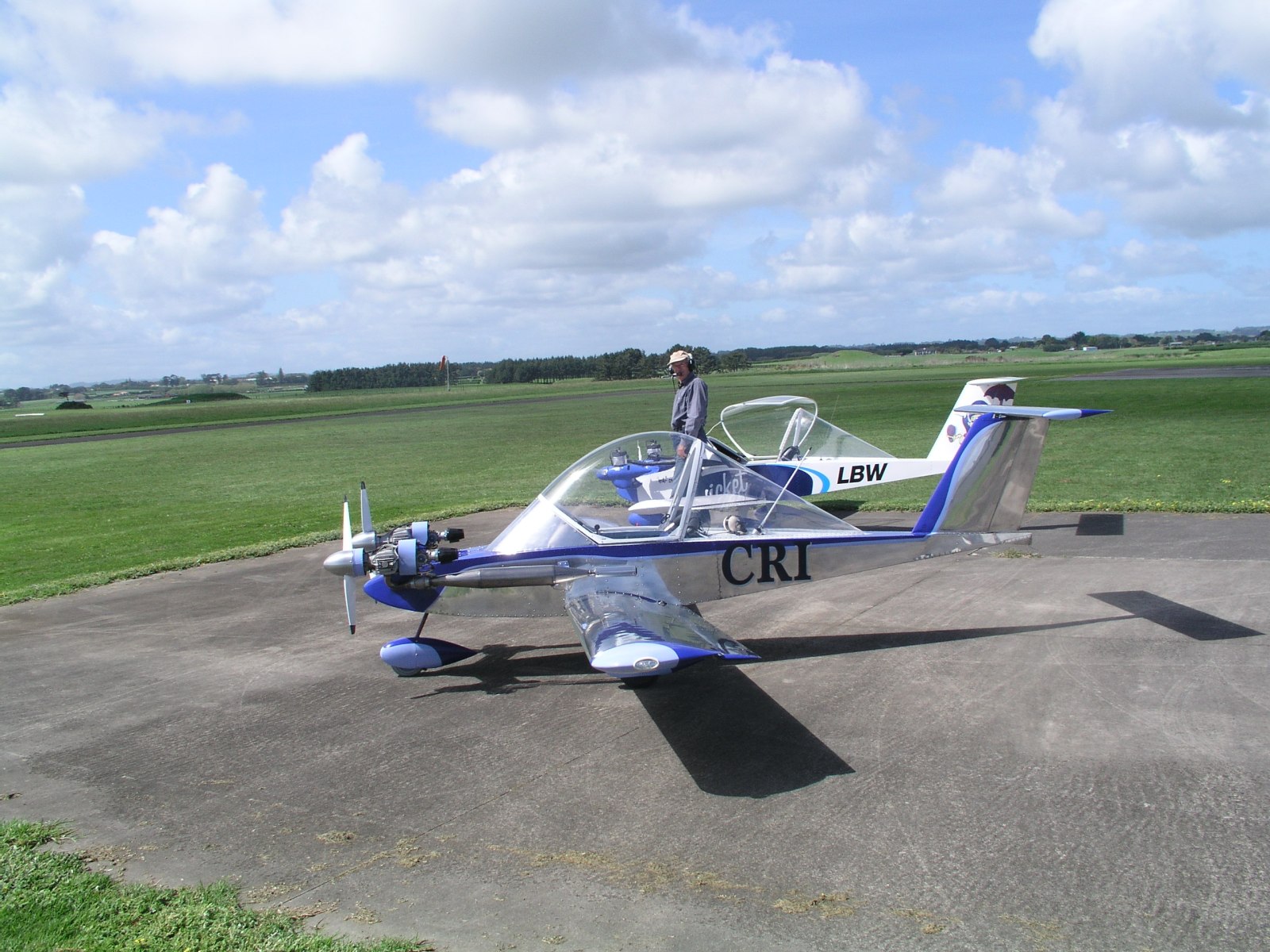
The Cricri is so small that you climb down into it. Sort of like getting into a go-kart. The canopy does hinge sufficiently clear of the fuselage for the pilot to stand on the seat, hands on each side of the fuselage – and slide your legs down over the fuel tank towards the rudder pedals – which you feel rather than see. The pedal tray is adjustable on rails so can be slid away or towards you for comfort. The seat is fixed and is cushioned with a single 12mm covered foam squab on a minimally shaped aluminium seat pan. With a small cushion behind your back its snug and comfortable. The harness is a light five piece unit but before you strap up – give some thought to starting the engines. For this flight the kindly instructor has offered to start your engines for you today, so stay in your seat.

Pitch trim on the right, Flaps on the left, fuel pressure bulb on the seat
Get familiar with the controls. The stick and rudders are comfortable and light. The stick forces are set with firm elastic bands. There is a trim adjust for ailerons on the stick, and pitch trim is a lever on the right wall of the fuselage that simply adjusts the centre of balanced elastic bands that preload the controls. Ailerons and pitch surfaces are all dynamically balanced so the control input forces are set by the tension in the elastic bands. The forces seem quite stiff on the ground, but the same control force in the air seems very light. They can be set to your preference. I prefer light controls. One unusual item is the brake, which is a single hydraulic bicycle lever mounted vertically on the control stick. Excursion is almost right to the stick to lock the wheels, but the brake can easily hold a full power ground run up.
Finally – the flaps deploy lever is on the left, opposite the trim lever. It has three detents: 27 degrees, 12 degrees and -3 degrees for cruise. The lever is a little difficult to reach because your elbow won’t fit past the upright of the seat back. If you have long arms you need to hook the control with your little finger to change flap settings. Make sure you are comfortable with this on the ground. A flapless landing is quite demanding as the Cricri is extremely slippery in flight.
All the switches, radio, and instruments and logically laid out on the small panel. Apart from an ASI you will be flying by glass for this flight.
Engine start

These little German made engines weigh less than 15 lbs and produce 22HP at 7000 RPM. The alternator is a home designed extra – fitted to the LH engine only
Unlike most Cricri’s, which are powered by French JPX engines of 18HP, my CRI has German made engines (3W 240cc ib2’s) which herald from the model aircraft stable and have dual electronic ignition and plugs producing 22HP. They usually start easily by hand if you get the mixture correct from the outset. Pressurise the fuel tank with a few puffs of the blood pressure bulb attached to the fuel tank vent hose. Brakes and ignition checks, throttle set and a few flicks has both engines burbling at a healthy 1800 RPM. When the LH engine comes to life the voltmeter should jump from battery voltage to charging voltage (14.5 volts) Battery life is perhaps 25 minutes if the alternator fails. Both engines stop abruptly when the battery depletes below 10 volts- so keep an eye on main bus voltage. That’s why the crammed panel has a space for a two inch voltmeter.
Climbing out
Taxiing is straightforward with no vices. Again – it feels like a go-kart. You may need the radio volume louder than usual because of the loud bark from the tuned engine exhausts that liberate their spent pulses of exhaust energy just 30 cm from each ear. Assuming checks all performed, radio calls in hand and you are now lined up – ready to roll. Full power delivers a nice little kick. There is no yaw as the engines have opposite directions of rotation. Roll is around 100 metres and take off is intuitive. One point to watch on climb out is airspeed. Don’t exceed 70 kts with flaps out, but this requires a steep angle of climb on full power. With both engines performing well and ¾ fuel the climb rate is 1300 ft/min. At 300 ft into the climb you now have to manoeuvre your left arm to retract the unwanted flap, using the little finger to slip the flap lever forward to its -3 degree cruise detent. As you throttle back the next distinctive Cricri issue presents itself – what I call “thrubbing” from asymmetrical engine RPM. Choose the RH engine to adjust as it’s the closest throttle lever. Trial and error will soon establish which engine is fast, or you can simply check the tachometers. They are sufficiently accurate to pick appropriate corrective throttle action.
Turns, Stalls and single engine.
Establish a 90 kt cruise, straight and level at your selected altitude. By now the engine RPMs should be balanced and you are just beginning to feel comfortable and in control. Re-trim for hands off flight. The first thing you are immediately aware of is the fabulous unimpeded view. The wings look tiny – but they are just over 2 metres reach out from the fuselage. You have this go-kart feeling again – light and very nimble in all directions. There is little lateral momentum so abrupt rolls and roll stops are straightforward. Pitch control is sensitive and may take a few trials to maintain a balanced turn without altitude gain. Yaw is not easy to detect so a yaw string – glider style – is taped to the canopy. It is a little too sensitive so you will have to tolerate small amounts of unplanned yaw.
It’s time to climb for stalls – and here you will encounter another Cricri feature that justifies a briefing. The stalls fall right on the book numbers: 39 kts, 44 kts and 49 kts with progressively less flap. However there is no buffet whatsoever – no warning – and the stalls at each configuration are abrupt and symmetrical – even with power applied. Once again, the opposite turning engines cancel the effect of torque completely. Recovery from the stalls is standard – but the relevance of a missing buffet is to avoid stalling the aircraft on to the ground at landing. On several approaches I have encountered a rapid loss of height as the airspeed washed off just a meter above the ground – particularly with full flap.
Single engine performance will only just sustain a gentle climb with around 1/3 rudder at 70 kts. I have had one engine failure – at 800 ft on take-off. The circuit was easily completed and a conventional landing was achieved without difficulty, but not without displacing a scheduled airline for a go around!
Landing

Landing at Raglan, one notch of flap deployed (Photo D Gwilliam)
As you approach for downwind you need circuit planning more typical for a high performance aircraft than a 400 lb Microlight. The Cricri is streamlined. The engines don’t like to idle. So begin to slow down early. Deploying flaps at 70 kts brings a minor pitch change but a major change in drag , so the descent on finals will be as steep as for a Cessna 152 with full flap. At low power some RPM settings are accompanied by unpleasant engine resonance and vibration, so the range of power settings will be less than you may be used to with normal aircraft engine.
At touchdown the suspension is very forgiving, but beware of the unexpected stall as you hold off. I suggest flying onto the ground a few knots above the stall speed. Use brakes as required. They hold straight and true. Return to the hanger for shutdown, debriefing, and a huge sigh.

Raglan (Photo D Gwilliam)
Wayne Butt
Taranaki Chapter
butt5@xtra.co.nz
 Wayne Butt Projects